
News
‘Recognise the role of local energy communities’
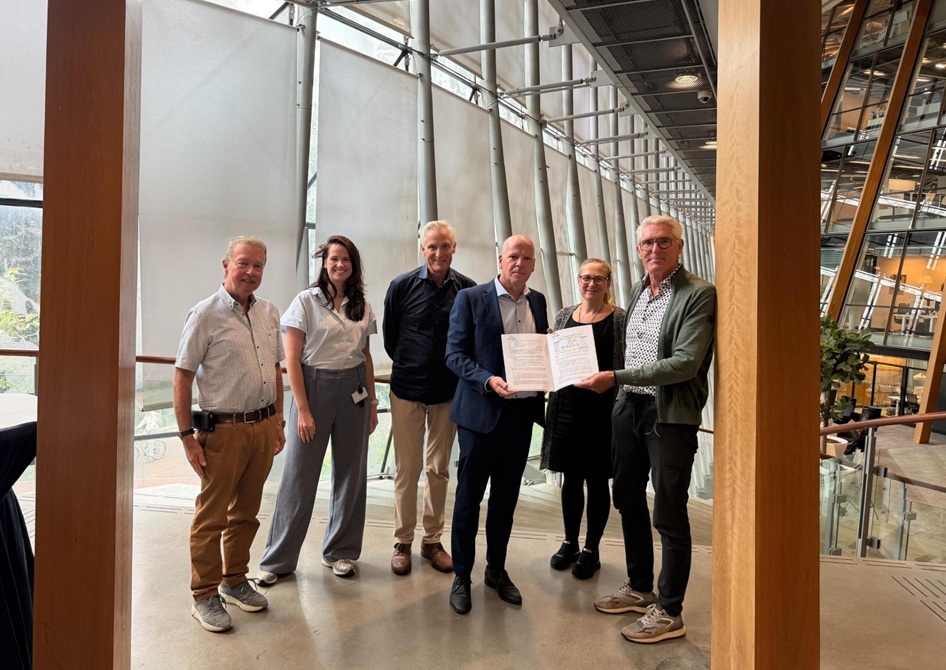
‘Recognise the role of local energy communities in our municipality’s future energy supply’. That, in a nutshell, is the call made by Energiek Alphen aan den Rijn (EA) to the mayor and aldermen. During a meeting with Councillor Gert-Jan Schotanus (energy transition), EA chairman Erik de Ruijter recently presented him with a detailed proposal to contribute ideas and collaborate on the municipality’s energy agenda.
At the end of May this year, the Municipal Executive published the coalition agreement: Alphen aan den Rijn 2026–2030, Growing Together Towards the Future. The councillors from the coalition parties – Nieuw Elan, CDA, PRO Alphen aan den Rijn and D66 – are now working on an implementation plan to put the agreement into practice. “We at Energiek Alphen would like to contribute to this practical implementation,” says Erik de Ruijter. He sees the EA proposal as a practical way of deepening the collaboration within the framework of the 2025–2028 agreement between the municipality and Energiek Alphen.
Local energy communities play a central role in the proposal. What are they, and how does an energy community work? De Ruijter: “An energy community consists of residents, businesses and organisations/institutions that use and produce energy together and try to match their supply and demand as closely as possible. As Energiek Alphen, we have already taken the first steps, together with a number of enthusiastic residents of Benthuizen, to form an energy community there. We call it a ”Glanskern’. Glanskern Benthuizen will be officially established in early 2027. Residents in Hazerswoude-Rijndijk, Koudekerk aan den Rijn and Groenendijk have also launched Glanskern projects, with Energiek Alphen providing them with advice and practical support. We are also making preparations for a third Glanskern in Alphen itself.”
According to …, energy communities are the government essential building blocks for the energy system of the future. And TNO has calculated that such decentralised developments could save up to 24.5 billion euros in grid investments. A large proportion of these savings stems precisely from what energy communities are already doing: combining local generation with smart storage and demand response. The new Energy Act also permits the sharing of energy within an energy community.
Glanskern Benthuizen
The Glanskern project in Benthuizen is a textbook example of how to build an energy community in collaboration with residents, businesses and organisations. Seven parties took part in the initial pilot: three residents, two businesses, a church and the football club. “They all have their own consumption profiles. Local involvement and a good mix of different consumption profiles are key conditions for the success of an energy community,” explains EA board member Menno Stijl. Watch this animation how the Glanskern Benthuizen was set up.
Stijl: ”We investigated and calculated in a simulation environment that the participants could achieve almost 100 per cent synchronisation with one another. This means that the energy generated by one participant is used by another participant at exactly the same time. They do not need the national grid for this. Participants make agreements amongst themselves, including on the price. Any surplus energy is stored in a neighbourhood battery. If they run short of energy, they buy more from the national grid. Alternatively, they can generate more renewable energy themselves, for example by jointly operating a small wind turbine. The profits go to the local community and do not end up in the pockets of shareholders of large international energy companies and Chinese wind turbine manufacturers.”
Federated community
Following the example of Glanskern Benthuizen, Energiek Alphen aan den Rijn aims to develop more small-scale, practice-based energy communities – both as an initiator and as a facilitator or by providing expert support to other initiators. “We’ll take what we learn from this and apply it to new projects. Every neighbourhood or area will have its own Glanskern. In the long term, this could lead to a federated community for Alphen aan den Rijn. That is what our proposal to the Mayor and Aldermen is about,” says Stijl.
De Ruijter: “We are not asking the council for a major new programme or a broad advisory role. Above all, we are asking for trust, scope, connection and practical cooperation. To begin with, by recognising the role of local energy communities in Alphen’s future energy supply and giving us scope to carry out the Glanskern projects. Incidentally, we have more to offer. We have a great deal of practical knowledge about energy saving and energy poverty. We will soon be celebrating the fact that we have now conducted two thousand energy advisory sessions with residents to help them take measures at home to reduce their energy consumption.”
“In all these ways, we can – in collaboration with other organisations such as Woonforte, the Food Bank and the VOA – help tackle energy issues at a local level. This is directly in line with the coalition agreement and the implementation agenda, which focus on energy justice, storage and flexibility, local ownership and collaboration with residents and civil society organisations,” said the chair of Energiek Alphen. Councillor Schotanus agrees. “Through local energy communities, energy saving and tackling energy poverty, we are committed to affordable, reliable and sustainable energy for everyone.”
Photo
EA board members Frank van Oudenhove (left), Ferd Schelleman (centre) and Erik de Ruijter (right) with Councillor Gert-Jan Schotanus and policy officers Lise de Vroed (left) and Berber Nijkamp (right).
