
News
Energy supply in your own hands
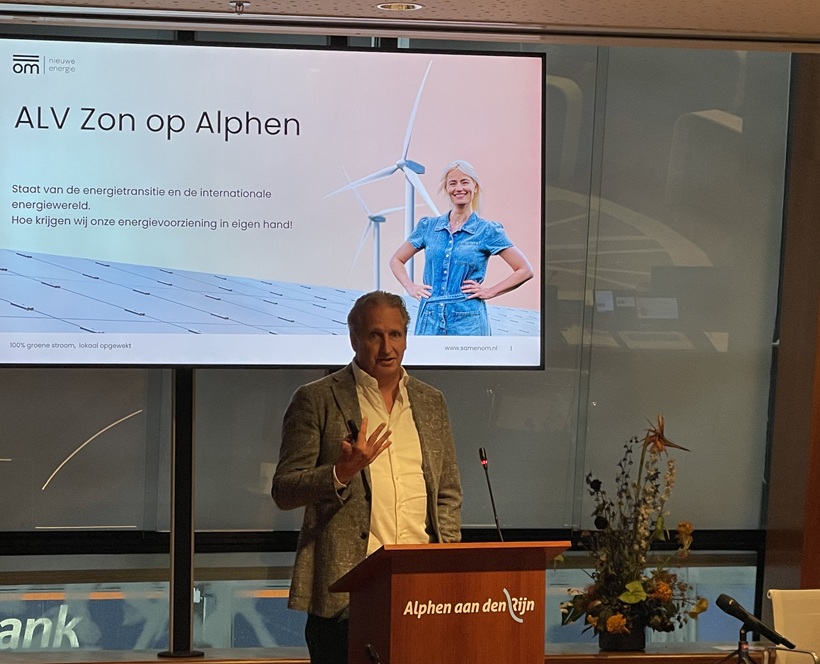
How do we take control of our energy supply, get a grip on the system and keep a grip on costs? During the General Assembly of Zon op Alphen on 19 May last, general director André Dippell of to|new Energy his views on developments in the energy market. His answer to the questions could be briefly summarised: build energy communities.
Energy communities are partnerships of residents, businesses and/or public parties that generate sustainable energy together (solar and wind) and share it with each other. That is: generating, using and storing as well as mutual settlement. This largely bypasses the large national energy network. As an energy community, you are less dependent on geopolitical developments and other market distortions. And: you determine the price yourself.
Energy sharing sounds easy. It can and it is allowed, as stipulated by the European Union and now regulated by the new Energy Act (2026). However, there is a lot involved in actually making it happen. to|nieuwe energie is involved in dozens of pilot projects in the Netherlands to enable energy sharing in practice. Examples include the so-called Glanskern pilots of Energiek Alphen aan den Rijn in Benthuizen and in Hazerswoude-Rijndijk Oost/Koudekerk/Groenendijk. In these cores, building local energy communities is now taking shape.
Also in the ‘core’ of Alphen, work is already underway to establish a local community: Glanskern Alphen Samen. In fact, the participants in Zon op Alphen also already form an energy community. For the members' meeting on 19 May, André Dippell was invited to give his views on the developments in the electricity market. There are many of those: there is almost daily news due to the situation in the Middle East and about our overcrowded power grid. High prices, looming shortages and issues such as grid congestion and the abolition of the balancing subsidy scheme also add to this.
More possible
After a brief introduction of to|new Energy, Dippell gave the more than 40 visitors to the ALV an insight into how the electricity market works. Some with prices per year and quarter, others with prices per day, hour and quarter. There is also the shift towards more and more renewable energy. “In the Netherlands, we already generate 56 per cent of our energy needs sustainably (solar and wind). That is great, but also indicates that more is still possible,” Dippell said. “I know it is a sensitive issue in this region, but for that we also need wind energy. With only solar energy, we will not get the energy transition done.”
According to Dippell, energy communities have a lot of potential. The government too now recognises this (see the Chamber letter dated 13 April 2026). In it, energy communities are called existential building blocks to strengthen decentralised developments in the energy system. “The letter confirms what we have been promoting for years: decentralised solutions, where generation, storage and consumption come together locally, are not only good for the climate, but also good for the affordability and reliability of the energy system.”
Cashing in on potential
The message is clear, argues Dippell. “Local generation, storage and consumption need to be better aligned. TNO has calculated that decentralised developments can save up to 24.5 billion euros on grid investments. Much of that saving comes precisely from what energy communities are already doing: combining local generation with smart storage and matched demand. The government really wants to cash in on this potential now. We are working with to|new energy fully participate. As a consumer, you can also participate by joining an energy community. Are you already converted?”
On behalf of the Zon op Alphen board, treasurer Erik de Ruijter added a few more suggestions to André Dippell's story. For instance, he urged participants to sign up to the pilot Glanskern Alphen Samen. This is entirely without obligation. You can sign up here. “Bear in mind that according to the Energy Act, everyone in an energy community should be a customer of the same supplier. In other words, make sure you can change energy suppliers in 2027. Do not conclude a new contract, as this will tie you down for another year. Let a current contract continue tacitly; you can usually terminate it with one month's notice.”
André Dippell's lecture has been recorded. Click here To see/listen to the recording again.
