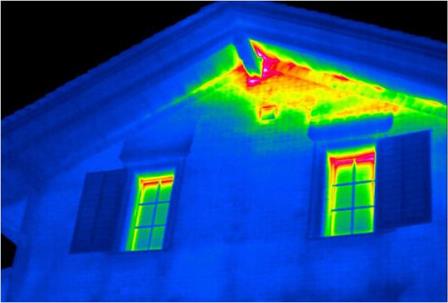
Thermal scan
In some cases, a heat scan can be a useful addition to the energy advice provided. If you are interested, you can request a heat scan of your home from Energiek Alphen. You can indicate this when completing the home file. (page 18). The Energy Coach will discuss with you whether a heat scan after the home visit will provide any additional information. The cost of a heat scan is 25 euros.
On this page, you can read more about what a heat scan is, why it is done, and the conditions for performing one.
For which properties?
Thermal scans are particularly suitable for homes built before 1990, as these houses are often less well insulated. Homes built after 1990 are already well insulated. However, there may be specific questions or issues that cannot be answered by a visual inspection.
The Energy Coach will determine whether a heat scan is appropriate for your home.
What is a thermal scan and why is it necessary?
A thermal scan involves using a special camera to take thermal images of the facades and, if possible, the roof. The images show where heat is escaping from the home and where it would be beneficial to install additional insulation. This can save up to £1,000 in heating costs per year. Living in a poorly insulated, draughty house is also unpleasant: it always feels cold. Good insulation makes your home more comfortable and is also healthier. Poor insulation (thermal bridges) can cause moisture and mould in walls and wood rot in floors and roofs.
The thermal imaging camera can be used to detect the following defects:
- missing or reduced insulation in facades and windows;
- wet or sagging insulation;
- thermal bridges (in the insulation);
- cracks, seams and holes.
Conditions for a heat scan
In order to properly detect heat leaks in a home, an outside temperature of 5 degrees or lower is required. There must be a 15-degree temperature difference between inside and outside. Night frost is ideal. The likelihood of this minimum temperature occurring is greatest from November to March. Heat scans are therefore usually carried out during this period. For planning purposes, it is also necessary to have a longer period of cold nights and no disruption from sunlight, precipitation or wind (no wind force 3 or higher) during the measurement. Early in the morning or when it is cloudy in winter are therefore the best conditions.
Practical information about the heat scan
- Leave the heating on at 20 degrees for 20 hours so that the house is properly warm.
- Switch off the heating approximately 1 hour before performing the heat scan.
- Leave the outdoor lights off during the night.
- Close windows, vents, etc. as much as possible.
- During recording, keep curtains, screens and similar items open.
Start time and duration of the heat scan
The heat scan starts just before sunrise. In November, this is around 8 a.m., in December/January around 8.30 a.m., in February around 8 a.m. and in March around 7.30 a.m.
Performing the heat scan takes approximately 1 hour (about 20 minutes outside and 40 minutes inside).
How does a thermal scan work?
A thermal scan is made with a special thermal imaging camera that can capture infrared heat radiation. That is why it is also known as an infrared photo. The camera contains a so-called microbolometer, which heats up due to infrared radiation. The temperature differences are converted into electrical voltage, which is then converted into an image. On most commonly used devices, blue indicates cold and red indicates heat.
Reporting and recommendations
The Energy Coach who performs the heat scan will draw up a report with recommendations. Click here to view an example of such a report.
Costs
The cost of a heat scan is 25 euros. You will receive an invoice for this by email from Energiek Alphen aan den Rijn.
Further information
You can request a heat scan when you apply for an energy consultation. The Energy Coach will discuss this with you in more detail during the consultation. Would you like more information? Please send an email to energiecoach@energiekalphen.nl.